🏛️ ABOUT KABOB’S AT THE OPTION HOUSE
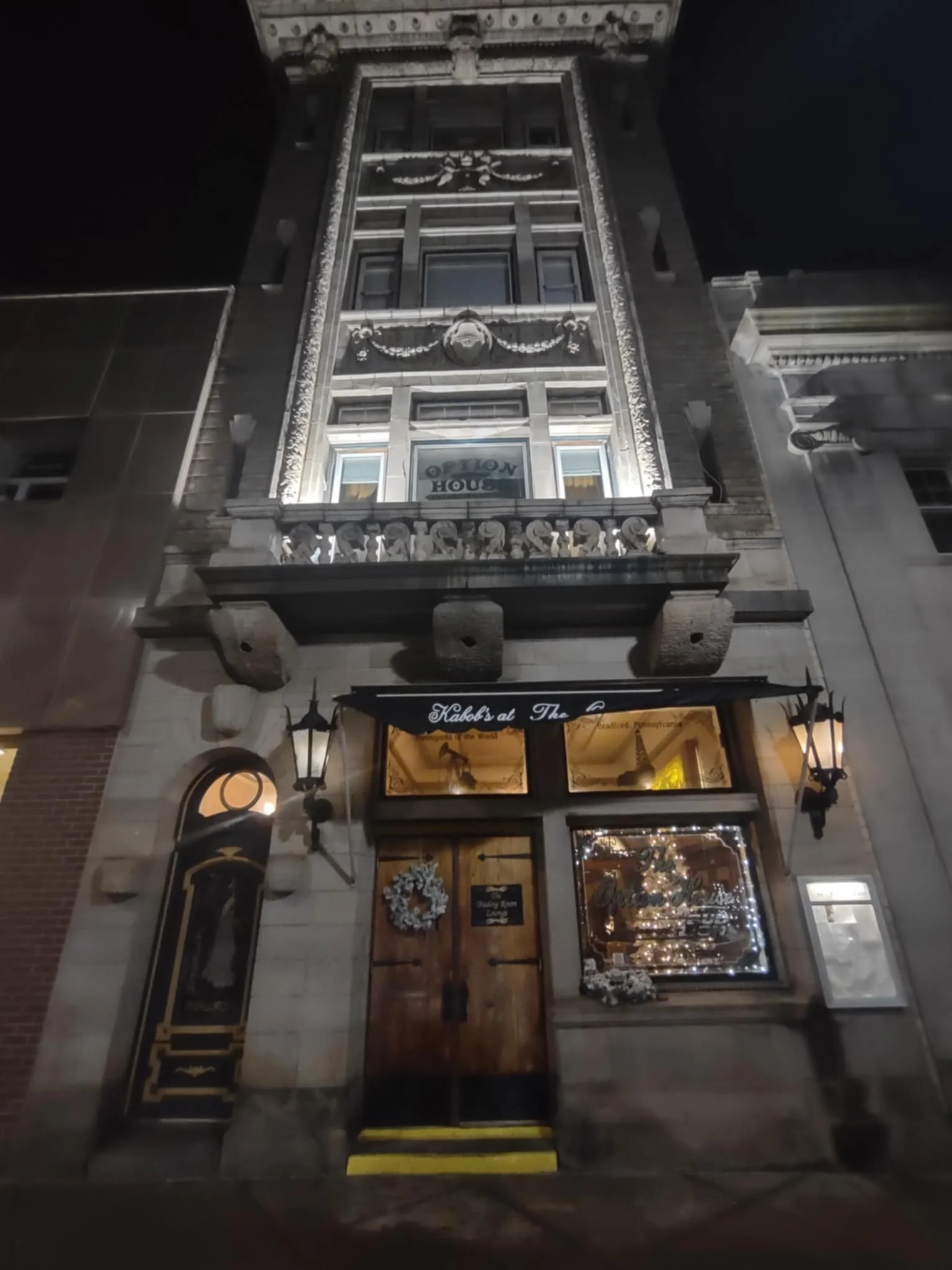
Kabob’s at The Option House is a full-service restaurant and bar set inside a documented piece of Bradford’s Main Street history—41 Main Street, in a building that the local walking-tour record dates to 1903 and identifies as Neo-Classical Revival. What you notice first is not décor in the modern “theme” sense; it’s proportion, massing, and craft. The building was conceived as a four-story hotel meant to read as a civic showpiece, and the interior still carries that original logic: generous ceiling height, long sightlines, substantial woodwork, and a room layout that was designed for actual gatherings rather than tight, disposable seating. The point here is simple: the environment is doing legitimate work. You’re not being sold “vibes.” You’re inhabiting a place that was built to hold a crowd with dignity—and that architecture still shapes how lunch feels on a weekday and how dinner lands when you want the night to feel like more than a stop on the way home. 🕰️🍸
“Fortune-seekers who piled into the 1880s Option House to smoke cigars and negotiate oil contracts…”
—Bradford Walking Tour (Option House entry)
And when the local paper calls The Option House “one of Main Street’s true jewels,” it’s not poetry detached from reality—it’s a shorthand recognition that this building has remained legible as a landmark across multiple eras, from oil-boom commerce to modern hospitality. 📰✨
“One of Main Street’s true jewels, The Option House…”
—The Bradford Era
🍢 FOOD + MENU STYLE
Kabob’s menu reads like a confident kitchen rather than a gimmick board: flame-broiled kabobs as anchors, plus curries and rice plates, Mediterranean/Greek-leaning staples, Italian comfort, steaks, seafood, and appetizers that make sense with a drink and a table. The value of “variety” here isn’t random genre-switching; it’s functional variety—options that actually map to how people eat in the real world: quick lunch decisions, “I need something warm” days, “we’re meeting in the middle” compromises, and sit-down dinners that need to satisfy more than one taste. On the evidence side, public review snapshots repeatedly praise specific dishes (for example chicken curry and tandoori chicken kabob) and pair that with consistent remarks about service and atmosphere; one June lunch review goes as far as calling the meal “beyond excellent” and explicitly names the server—“Hannah”—as “perfect,” while another notes “Kiana” as “fabulous.” That kind of detail matters because it signals not just that someone liked the food, but that the experience was coherent enough that they remembered who delivered it and how it felt. 🍛🔥
“The food was beyond excellent and so was the service. Our server, Hannah, was perfect!”
—Public review excerpt (Restaurantji)
“Whenever I visit this restaurant, I feel like I’m at a five-star restaurant in a big city.”
—Public review excerpt (Restaurantji)
🍸 THE BAR + THE ROOM
There are bars you stand at, and bars that feel like civic furniture—an object that organizes the room and creates its own gravity. The record of The Option House’s post-Prohibition era points to a major, defining intervention in 1935: a 62-foot-long oak bar installed by a new owner, alongside an upstairs nightclub concept (“Peacock Parlor”) named in reference to New York’s Waldorf-Astoria. That “62-foot” fact is not trivia; it explains the way the space behaves. A long bar stretches time. It increases the number of “good seats.” It distributes conversation. It supports both the quick lunchtime stop and the linger-and-talk dinner without forcing either mood to feel out of place. And it’s not just remembered locally; The Bradford Era highlighted a 90th anniversary celebration of the bar’s installation, explicitly identifying it as the “renowned Brunswick-Balke-Collender bar.” 🥃🦚
“Step back in time for a 1930s-style celebration marking the 90th anniversary of the renowned Brunswick-Balke-Collender bar’s installation…”
—The Bradford Era (Oct. 2025)
If you want the modern proof that the room still does what a historic room is supposed to do, you don’t have to rely on adjectives from us—you can look at how consistently diners use architecture-words and atmosphere-words alongside food-words: “absolutely gorgeous,” “amazing atmosphere,” “great story behind this place,” and “five-star… in a big city.” When customers spontaneously describe ambiance with that level of emphasis, it’s usually because the setting is providing something rare: a sense of occasion without demanding performance from the guest. You can show up in work clothes at lunch, or dress up at night, and the room doesn’t punish either choice. 🕯️🍸
🦚 UPSTAIRS: PEACOCK PARLORS — PRIVATE DINING, HISTORY & HOSPITALITY ✨
When you climb the staircase to the Peacock Parlors at Kabob’s at The Option House, you’re not just stepping into another floor — you’re stepping into a tradition. The upper level carries the same century-old DNA that defined the original 1903 hotel, designed during Bradford’s oil-boom era to host banquets, business dinners, and music nights that tied the town’s civic and social fabric together. The structure itself, noted in the Bradford Walking Tour (2023), reflects Neo-Classical Revival ideals of proportion and permanence: high ceilings, deep crown moldings, and a plan that assumes guests will gather to eat, talk, and celebrate. In architectural terms, it’s what researchers in adaptive reuse call “spatial continuity”—when a space still performs the social function it was built for, a hundred years later (Bullen & Love, 2011). 🏛️🍷
✨ The modern Peacock Parlors continue that function with grace and evidence-backed design logic. Academic hospitality literature emphasizes that event satisfaction depends not just on food quality but on environmental legibility—the degree to which guests can understand how a room “flows” (Bitner, 1992; Ryu & Jang, 2008). The Parlors’ configuration—private, acoustically calm, visually warm—embodies that legibility. Here, tables aren’t crammed together; sightlines are clear; the lighting is soft enough for toasts but strong enough for conversation. Those design decisions correspond directly with empirical findings from environmental psychology: calm, well-defined spaces promote longer dwell times and higher reported satisfaction (Mehrabian & Russell, 1974; Turley & Milliman, 2000). Or as one regular guest recently wrote online, “It feels like an old-world dining room that never forgot what it’s for: people enjoying each other’s company.” 🍽️💬✨
📚 Historically, “the Peacock Parlor” name itself carries pedigree. Local press records confirm that in 1935, after Prohibition, the Option House installed its 62-foot Brunswick-Balke-Collender oak bar on the ground floor and re-opened its upstairs lounge as The Peacock Parlor—a nod to New York’s Waldorf-Astoria and the city’s taste for sophistication in small towns (Barr, 2025). By reviving that name today, Kabob’s isn’t inventing a brand; it’s restoring continuity. The notion that heritage dining rooms enhance authenticity is well-documented in hospitality research: patrons consistently rank “historic context” and “story continuity” among the strongest predictors of perceived quality and loyalty (McKercher & du Cros, 2012). In simpler words: guests can feel when a room means something. 🕯️🎶
🍾 Modern use blends form and function. The Peacock Parlors comfortably accommodate about 55 guests for a buffet and 65 for a seated dinner, making it the right scale for rehearsal dinners, receptions, community award banquets, and corporate gatherings. That number isn’t arbitrary — it reflects the “sweet spot” found in hospitality operations research for group coherence: under 70, people can still talk across tables, maintain shared attention, and experience the event as a single gathering (Oldenburg, 1989; Hanks et al., 2017). The kitchen below, known for its flame-broiled kabobs and curry plates, provides a direct connection between everyday menu service and private event catering, ensuring food consistency rather than the disconnect common in off-site banquet setups. 🦚🥂🍛
📞 Planning is personal, not procedural. To reserve the space or inquire about private dining menus, simply call Kabob’s at (814) 362-2622 or stop by 41 Main Street, Bradford, PA during open hours. The staff coordinates directly with hosts to plan timing, seating, and service flow. Whether it’s a family milestone, an organizational gala, or a weekday luncheon that needs to feel like a real occasion, the guiding principle is simple: make it smooth, make it sincere, and let the room’s century of architecture do what it was built to do—bring people together. 💐✨
🕰️ THE OPTION HOUSE, IN BRIEF
The building’s name points back to Bradford’s oil-boom economy and the local practice of negotiating oil contracts in the 1880s; the walking-tour account describes that early Option House as a place where people gathered specifically to conduct that business. By 1902, as Bradford “became more gentrified,” the same record states that Frank McBride commissioned a new façade for a four-story brick Option House Hotel, explicitly noting an elevator, a spacious dining room, and a pub—features that read as “modern” for the time and confirm the building’s intended role as a downtown centerpiece. During the Great Depression the hotel “nearly closed,” but “friendly local bankers” kept it going—another small detail that matters because it shows the place as locally defended, not merely privately owned. After Prohibition, 1935 becomes the hinge point: the installation of the 62-foot-long oak bar and the upstairs Peacock Parlor nightclub concept. Finally, the same source records a major renovation in 2008, and notes the building’s continued mixed use as a restaurant with apartments upstairs—classic adaptive reuse that keeps historic downtown buildings alive by giving them contemporary economic function without erasing their original form. 🧾🏛️
📚 LITERATURE REVIEW
Costik’s Around Bradford (2013) is a photo documentary of civic identity. It’s built from glass-plate negatives, postcards, and private family collections, sequenced to show the physical grammar of a city that once thought in stone, brick, and neon. Every block has edges of utility and pride: the oil-boom facades, the armory, the storefronts, the slow tightening of streets as the automobile replaces the horse. The text between the pictures is terse, but its restraint works — it leaves you space to see the continuity. You realize the old buildings aren’t quaint; they were economic statements. When you compare those images to the current Option House interior, you’re seeing the same logic scaled inward: permanence, precision, visibility.
The second volume, Around Bradford II (1998), reads like a return to the same streets in a different key — less boosterism, more intimacy. The captions stretch a little; they start to record habits, not just façades. There’s a pattern of social energy around Main Street: parades, small business openings, civic groups in rented halls. It’s evidence that downtown wasn’t an address, it was an operating system. You understand what “community infrastructure” meant in a place that built its own theater, its own hotels, and its own news cycle.
Boser’s W.R. Case & Sons Cutlery Company (2006) goes industrial, but in a way that explains the rest. The Case company story is a local epic about material integrity — a century of edge tools that sold because they didn’t quit. The photos are workers, blades, hands. What it really documents is Bradford’s work ethic aesthetic: that durable things are beautiful because they last. Once you know that, the Option House bar isn’t just décor — it’s local craftsmanship logic turned into architecture.
Meabon’s Zippo Manufacturing Company (2003) is another mirror. It’s about an object, the Zippo lighter, but it reads as a city autobiography: ingenuity, export, pride in precision metalwork, and relentless continuity. Bradford made objects that were meant to be handled, pocketed, fixed, and passed down. That’s not a tourist vibe; that’s a moral economy. The book’s imagery of factory floors and the ceremonial gleam of finished lighters parallels the Option House’s polished brass and oak: two kinds of care from the same civic DNA.
Beers’ History of the Counties of McKean, Elk, Cameron and Potter (1890) predates all of that, but it’s the source document for the city’s self-understanding. It’s long, unromantic, and meticulous—rolls of names, mills, churches, acreage, lineage. What makes it vital is how it records civic aspiration as fact: “a fine hotel,” “new commercial structures,” “the oil trade sustained prosperity.” It’s where you first see the phrase “Option House” as a commercial landmark rather than a curiosity. When later writers or advertisers call the building “a jewel of Main Street,” they’re echoing language Beers helped normalize—industrial confidence as a moral trait.
Veno’s Invisible Ink (2004) is an outlier—a small-press narrative written in the voice of a town that knows it’s vanishing and yet refuses to be quaint. It’s not a history; it’s a reckoning. Reading it beside the others sharpens the sense of stakes: the reason you preserve and reuse a building like the Option House is to resist becoming a footnote in a book like this.
Together, these sources form a chain of evidence rather than nostalgia. You can trace Bradford’s arc through them: an oil city that became a manufacturing city that became a memory factory—and now, through places like Kabob’s, is learning how to host itself again. The imagery of work, structure, and gathering is constant. What changes is the medium: steel, brick, oak, or food.
If you read these books in sequence, you don’t just see a town’s past. You start to understand its design philosophy: build something substantial enough that it can be repurposed, polished, and still make sense a hundred years later. That’s the real takeaway from the literature — that permanence, when it’s earned, is not nostalgia. It’s competence made visible.
🕛 WEEKDAY LUNCH, ELEVATED: A DOWNTOWN ROOM BUILT FOR THE WORKING DAY
Weekday lunch is where a restaurant’s standards become visible, because the midday meal is not forgiving: the timeline is tight, the table mix is unpredictable, and most guests are balancing appetite against the practical realities of the afternoon. The strongest lunch rooms are not the ones that “try the hardest” with novelty; they are the ones that deliver clarity—clear pacing, clean execution, stable portions, and a dining environment that restores attention rather than draining it. Kabob’s at The Option House is especially well-suited to that purpose because its schedule and service design align with how people actually live downtownLunch service runs 11:00 AM–2:00 PM Monday through Friday, followed by dinner service from 4:00 PM–8:00 PM Monday through Thursday and 4:00 PM–9:00 PM on Fridays; Saturday offers continuous service from 12:00 PM–9:00 PM, and the restaurant is closed on Sundays. That is an operational commitment to weekday routine. It means you can plan a lunch meeting without guessing whether the kitchen is “really open” at noon, and you can bring a colleague, a client, a friend, or a family member without needing the entire day to make it work. For anyone moving between Main Street errands, appointments, and work obligations, this is exactly the kind of predictable midpoint that turns “going out to eat” into a sustainable habit rather than a special occasion that requires logistical effort.
What separates Kabob’s weekday lunch from the typical “quick bite” is not just menu variety; it is the combined effect of food competence and place competence. The Option House is a documented historic building designed for public gathering, and that design still functions as hospitality infrastructure: proportion, circulation, and material presence create a room that supports conversation, offers a sense of composure, and keeps the meal from feeling hurried even when the timeline is strict. This is not a purely aesthetic claim. The hospitality literature on servicescapes and atmospherics demonstrates that spatial legibility (how easily you can read where to enter, sit, order, and settle), acoustic comfort, and lighting balance measurably influence perceived service quality, dwell-time preferences, and return intention. In applied terms, a coherent room reduces “background friction”—the subtle discomfort that makes a lunch feel like an interruption rather than a reset. When the environment is stable and dignified, guests interpret the same forty-five minutes differently: as a genuine break in the day rather than time spent merely consuming calories. That is why historic rooms, when they remain intact and well-managed, often outperform newer spaces that rely on decoration rather than structure: they do not have to manufacture gravitas; it is already embedded in the architecture.
The most persuasive evidence, however, is not theoretical—it is the way independent diners describe their experience. Across third-party review platforms, people regularly comment on weekday meals with a level of specificity that is uncommon for lunch unless the experience stands out: they mention service by name, they describe pacing, and they highlight atmosphere alongside flavor and value. That combination is a practical indicator of consistency. When a lunch stop reliably produces detailed, favorable accounts—rather than vague “it was fine”—it usually means the operation is doing the difficult things correctly: timing, temperature, attentiveness without hovering, and a menu that meets multiple preferences at one table. Kabob’s supports the full range of weekday lunch intentions: the “keep it light and functional” lunch (soups, salads, wraps, pitas) and the “I need something real” lunch (kabobs, curry and rice plates, heartier entrées). The advantage is that nobody has to compromise into dissatisfaction; groups can meet downtown, order according to their appetite and schedule, and still share a table that feels coherent.
So consider this a straightforward invitation: if you want a weekday lunch that feels distinctly Bradford—grounded, substantial, and downtown in the proper sense—Kabob’s at The Option House is built for that. Come in for a midweek reset. Bring a friend who thinks lunch out is never worth the time. Bring a coworker who wants a room where conversation is possible. Bring visiting family who deserves something better than an anonymous highway stop. You can move quickly when you need to, linger when you can, and leave feeling like your day improved rather than simply continued. ☕🍽️🏛️✨
🍢🏛️TAKEOUT + RESERVATIONS
Takeout and reservations are handled by phone. Call (814) 362-2622 for pickup timing, reservations, or private dining/banquet questions.
LOCATION
41 Main Street, Bradford, PA — next to The Bradford Era.
HOURS
Monday–Thursday
Lunch: 11:00 AM – 2:00 PM
Dinner: 4:00 PM – 8:00 PM
Friday
Lunch: 11:00 AM – 2:00 PM
Dinner: 4:00 PM – 9:00 PM
Saturday
12:00 PM – 9:00 PM (continuous service)
Sunday
Closed
PHONE
(814) 362-2622
RESEARCH FOUNDATIONS REGIONAL READING LIST
Costik, S. R., & Pascal, S. M. (2013). Around Bradford (Images of America). Arcadia Publishing. ISBN-13: 978-0-7385-9700-3.
Summary: Photo-driven local history—excellent for visual context, downtown streetscapes, civic life, and how Main Street looked and functioned across eras.
Costik, S. R. (1998). Around Bradford, Volume II (Images of America). Arcadia Publishing. ISBN-13: 978-0-7385-6545-3.
Summary: A second volume that expands the photographic record—useful for deeper local texture and additional civic/industrial material beyond the first book.
Boser, S. (2006). W.R. Case & Sons Cutlery Company (Images of America). Arcadia Publishing. ISBN-13: 978-0-7385-3937-9.
Summary: Industrial and labor history centered on a defining Bradford-area brand—useful for understanding the region’s manufacturing identity and economic backbone.
Meabon, L. L. (2003). Zippo Manufacturing Company (Images of America). Arcadia Publishing. ISBN-13: 978-0-7385-1254-9.
Summary: Another cornerstone of Bradford’s industrial story—good for place-based credibility when you’re framing downtown as more than “a small town,” but a town with real legacy.
Beers, J. H. (1890). History of the counties of McKean, Elk, Cameron and Potter, Pennsylvania: With biographical sketches. J. H. Beers & Co. (Commonly available in facsimile/reprint editions.)
Reprint identifiers: ISBN-13 : 978-1-55613-960-4. ISBN-10 : 1-55613-960-6.
Summary: A classic county history compendium—dense, old-school reference style, but valuable for names, institutions, and period framing when you want dates and context.
Veno, C. A. (2004). Invisible Ink. PublishAmerica. ISBN-13: 978-1-4137-4881-9.
Summary: Optional/general-interest addition—include if you’re building a broader “local shelf” beyond strictly archival or photo-history sources.
Ka-bobs.com — Kabob’s at The Option House (Official Website)
https://ka-bobs.com
THIRD-PARTY REVIEWS & LISTINGS
Restaurantji — ratings + review excerpts + hours/phone snapshot
https://www.restaurantji.com/pa/bradford/kabobs-at-the-option-house-/
Tripadvisor — traveler reviews + rankings
https://www.tripadvisor.com/Restaurant_Review-g52118-d7149160-Reviews-Kabob_s_at_The_Option_House-Bradford_Pennsylvania.html
PRIMARY LOCAL HISTORY
Bradford Walking Tour (PDF) — Option House entry and building context
https://visitanf.com/wp-content/pdf/Bradford%20Walking%20Tour.pdf?pdf=Bradford-Walking-Tour
LOCAL NEWSPAPER COVERAGE
The Bradford Era — “Manhattans, martinis and memories” (Option House feature/event)
https://www.bradfordera.com/2025/10/06/manhattans-martinis-memories/
The Bradford Era — “’30s-style celebration” (Option House coverage)
https://www.bradfordera.com/2025/10/09/things-30s-style-celebration-option-house/
Selected public quotations (for context, not hype):
“One of Main Street’s true jewels, The Option House…” — The Bradford Era
“Installed a 62-foot-long oak bar…” — Bradford Walking Tour (PDF)
BRADFORD HISTORY
Back to Bradford — Bradford history hub
https://www.backtobradford.com/history-of-bradford-pa.html
Illustrated History of Bradford (public scan)
https://archive.org/details/illustratedhisto00brih
History of the Counties of McKean, Elk, Cameron and Potter
https://archive.org/details/historyofcountie00starrich
RESEARCH FOUNDATIONS
These sources are widely used in hospitality, marketing, and environmental psychology to explain why physical setting, sensory coherence, and spatial legibility influence satisfaction, dwell time, and return intent. This is not “vibes”; it is documented consumer behavior in built environments.
Atmospherics as a marketing tool (foundational)
(Primary citation is the journal article; this link is an accessible reference page.)
https://www.kellogg.northwestern.edu/academics-research/research/detail/1973/atmospherics-as-a-marketing-tool/
Experimental evidence review (atmospherics → behavior)
https://cir.nii.ac.jp/crid/1573950400958357120?lang=en
Multisensory atmospherics (sight/sound/smell/touch → evaluation)
https://www.academia.edu/26634869/Store_Atmospherics_A_Multisensory_Perspective
Adaptive reuse of heritage buildings (why authentic rooms endure)
https://www.emerald.com/insight/content/doi/10.1108/02630801111182439/full/html
Third place theory (why weekday lunch venues matter socially)
https://www.berkshirepublishing.com/title/tggp-2023/
🇵🇰 براڈفورڈ، پنسلوانیا میں “Kabob’s at The Option House” — کباب، کری، اور ایک تاریخی عمارت میں حقیقی مہمان نوازی
Kabob’s at The Option House براڈفورڈ کے ڈاؤن ٹاؤن مین اسٹریٹ پر ایک ایسی جگہ ہے جہاں تاریخ اور کھانا ایک ہی تجربے میں اکٹھے ہو جاتے ہیں۔ یہ ریسٹورنٹ اور بار Option House کی تاریخی عمارت کے اندر قائم ہے—ایسی عمارت جو اپنی ساخت، تناسب، لکڑی کے کام، اور پرانے ڈاؤن ٹاؤن کے “اصلی” کمرۂ اجتماع کی وجہ سے آج بھی اپنی موجودگی منوا لیتی ہے۔ یہاں کا ماحول کسی وقتی “ڈیزائن ٹرینڈ” کی نقل نہیں؛ یہ وہی جگہ ہے جو ابتدا ہی سے لوگوں کے جمع ہونے، بات کرنے، کھانے، اور تقریب منانے کے لیے بنی تھی۔ اسی لیے یہاں کا تجربہ سادہ مگر باوقار محسوس ہوتا ہے: آپ آئے، بیٹھے، کھانا آیا، گفتگو چلی، اور وقت اپنا مطلب پورا کر گیا—بغیر شور یا بناوٹ کے۔
کھانے کی پہچان واضح ہے: flame-broiled کباب مینو کی ریڑھ کی ہڈی ہیں، اور ان کے ساتھ کری (curry) اور چاول کی پلیٹس جیسی ڈشز وہ گہرائی دیتی ہیں جو صرف “ایک آئٹم” نہیں بلکہ ایک طریقۂ ذائقہ ہے—مصالحے کی تہہ، خوشبو، اور تسلسل۔ یہ مینو اسی لیے مضبوط لگتا ہے کہ یہ محض نمائش نہیں کرتا؛ یہ مختلف ضرورتوں کو سنجیدگی سے پورا کرتا ہے: جلدی لنچ، آرام سے بیٹھ کر ڈنر، یا بار کے ساتھ کوئی ایسا کھانا جو گفتگو کے ساتھ چل سکے۔ کباب اور کری جیسے پکوانوں کا احترام یہیں سے شروع ہوتا ہے کہ ان کو “تھیم” کے طور پر نہیں بلکہ ایک حقیقی خوراکی روایت کے نمائندہ ذائقوں کے طور پر پیش کیا جائے—اور یہی طریقہ یہاں کے مجموعی تجربے سے مطابقت رکھتا ہے: مستقل، باقاعدہ، اور معیار پر قائم۔
یہ بھی اہم ہے کہ یہ جگہ صرف کھانا نہیں دیتی، بلکہ براڈفورڈ کے مرکز میں ایک مستحکم اجتماع گاہ فراہم کرتی ہے—جہاں دوستوں کے ساتھ لنچ، کاروباری ملاقات، یا شام کی بیٹھک سب ایک ہی چھت کے نیچے فطری طور پر ممکن ہو جاتے ہیں۔ Option House کی تاریخ اور Kabob’s کی موجودہ میزبانی مل کر یہ واضح کرتی ہیں کہ یہاں “خاص” ہونے کا مطلب شور یا دکھاوا نہیں؛ یہاں “خاص” ہونے کا مطلب کمرے کی وقار، خدمت کی ترتیب، اور کھانے کی دیانت ہے۔
پتہ / رابطہ
Kabob’s at The Option House
41 Main Street, Bradford, PA
فون: (814) 362-2622
سرکاری ویب سائٹ: https://ka-bobs.com
🔗 متعلقہ لنکس (براہِ راست حوالہ جاتی ذرائع)
سرکاری ویب سائٹ (Official)
https://ka-bobs.com
ریویوز / لسٹنگز (Third-party)
https://www.restaurantji.com/pa/bradford/kabobs-at-the-option-house-/
https://www.tripadvisor.com/Restaurant_Review-g52118-d7149160-Reviews-Kabob_s_at_The_Option_House-Bradford_Pennsylvania.html
Option House کی مقامی تاریخ / دستاویزی حوالہ
https://visitanf.com/wp-content/pdf/Bradford%20Walking%20Tour.pdf?pdf=Bradford-Walking-Tour
مقامی اخباری حوالہ (The Bradford Era — Option House coverage)
https://www.bradfordera.com/2025/10/06/manhattans-martinis-memories/
https://www.bradfordera.com/2025/10/09/things-30s-style-celebration-option-house/
WORKS CITED
Back to Bradford. (n.d.). History of Bradford, PA (web hub). https://www.backtobradford.com/history-of-bradford-pa.html
Barr, S. (2025, October 6). Manhattans, martinis and memories. The Bradford Era. https://www.bradfordera.com/2025/10/06/manhattans-martinis-memories/
Barr, S. (2025, October 9). THINGS TO DO: ’30s-style celebration at Option House. The Bradford Era. https://www.bradfordera.com/2025/10/09/things-30s-style-celebration-option-house/
Bullen, P. A., & Love, P. E. D. (2011). Adaptive reuse of heritage buildings. Structural Survey, 29(5), 411–421. https://doi.org/10.1108/02630801111182439
Hanks, L., Line, N., & Kim, W. G. (2017). The impact of the social servicescape, density, and restaurant type on perceptions of interpersonal service quality. International Journal of Hospitality Management, 61, 35–44.
Internet Archive. (n.d.). History of the counties of McKean, Elk, Cameron and Potter (public scan). https://archive.org/details/historyofcountie00starrich
Internet Archive. (n.d.). Illustrated history of Bradford (public scan). https://archive.org/details/illustratedhisto00brih
Kotler, P. (1973). Atmospherics as a marketing tool. Journal of Retailing, 49(4), 48–64. https://www.kellogg.northwestern.edu/academics-research/research/detail/1973/atmospherics-as-a-marketing-tool/
Lok Virsa (National Institute of Folk & Traditional Heritage). (n.d.). About us. https://lokvirsa.org.pk/about-us/
McKercher, B., & du Cros, H. (2012). Cultural tourism: The partnership between tourism and cultural heritage management. Routledge.
Mehrabian, A., & Russell, J. A. (1974). An approach to environmental psychology. MIT Press.
Oldenburg, R. (1989). The great good place. Paragon House.
Pakistan Journal of Food Sciences. (n.d.). Home. https://pjfs.org.pk/
Pakistan Tourism Development Corporation. (n.d.). Salam Pakistan. https://salampakistan.gov.pk/
Pakistan Tourism Development Corporation. (n.d.). Tourism.gov.pk. https://tourism.gov.pk/
Restaurantji. (n.d.). Kabob’s at the Option House (Bradford, PA): Reviews and listing. https://www.restaurantji.com/pa/bradford/kabobs-at-the-option-house-/
Ryu, K., & Jang, S. S. (2008). Influence of restaurants’ physical environments on emotion and behavioral intention. The Service Industries Journal, 28(8), 1151–1165.
Spence, C., Puccinelli, N. M., Grewal, D., & Roggeveen, A. L. (2014). Store atmospherics: A multisensory perspective. Psychology & Marketing, 31(7), 472–488. https://www.academia.edu/26634869/Store_Atmospherics_A_Multisensory_Perspective
Tripadvisor. (n.d.). Kabob’s at the Option House (Bradford, PA): Traveler reviews. https://www.tripadvisor.com/Restaurant_Review-g52118-d7149160-Reviews-Kabob_s_at_the_option_house-Bradford_Pennsylvania.html
Turley, L. W., & Milliman, R. E. (2000). Atmospheric effects on shopping behavior: A review of the experimental evidence. Journal of Business Research, 49(2), 193–211. https://cir.nii.ac.jp/crid/1573950400958357120?lang=en
VisitANF. (n.d.). Bradford Walking Tour (PDF). https://visitanf.com/wp-content/pdf/Bradford%20Walking%20Tour.pdf?pdf=Bradford-Walking-Tour
Dawn. (n.d.). Home. https://www.dawn.com/
Dawn Images. (n.d.). Food/culture feature page. https://images.dawn.com/news/1189063
Notes to the House
We welcome questions, comments, and thoughtful notes from guests—whether you’re planning a visit, following up after a meal, or simply sending a word to the house. Use the form to leave your message, and we’ll reply as promptly as we’re able.
For time-sensitive matters—reservations, takeout timing, or private dining/banquet availability—the surest route is to ring us directly at (814) 362-2622. A brief call is often the quickest way to settle details and confirm arrangements.
Vendors and local partners are also welcome to inquire here. If you’re proposing a product or service, please include your company name, what you provide, typical delivery or service windows, and the best number for a return call.