The Brunswick Bar
The 62-Foot Oak Bar of The Option House
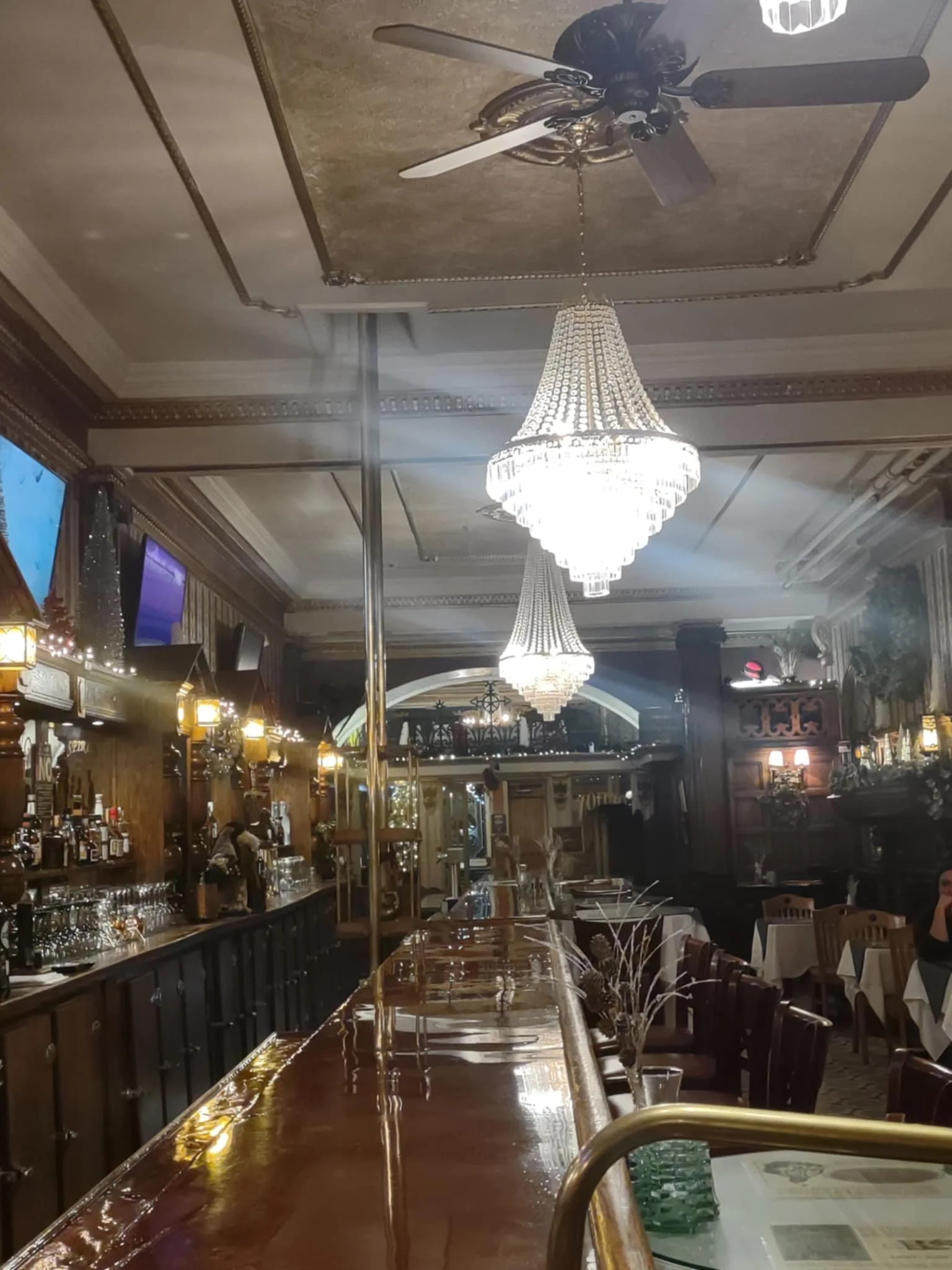
The Brunswick Bar at Kabob’s at The Option House is more than a handsome place to order a drink. It is architectural furniture: a built object large enough to organize a room, preserve touch, frame conversation, and carry almost a century of post-Prohibition hospitality. This archive gathers the building evidence, Brunswick company context, woodcraft vocabulary, Bradford history, Prohibition economics, and source links that make the bar worth studying, photographing, preserving, and enjoying. 🍸🪵🏛️
🧱 Why the bar matters
A long bar is not just a counter. It is a social instrument. It arranges posture, sound, eye contact, service rhythm, bottle display, glassware, waiting, joking, storytelling, and memory. At 62 feet, the Option House bar becomes part of the room’s architecture. It is long enough to feel ceremonial: a line of polished oak that turns ordinary service into a historic encounter.
The bar also marks a precise national turning point. Installed in 1935, it belongs to the years after the repeal of national Prohibition. The old saloon world had been legally suppressed, speakeasy culture had flourished underground, and public drinking returned under a new legal order. In that context, installing a grand oak bar was not only decoration. It was a declaration that public hospitality had returned.
🏭 Brunswick-Balke-Collender: the company behind the legend
Brunswick-Balke-Collender belongs to the great American history of manufactured leisure. The company lineage begins with John Moses Brunswick, whose billiards and woodworking enterprise grew into a national name. Brunswick Billiards describes a legacy of innovation, billiards, quality, and adaptability, including the company’s expansion across the United States and its survival through changing markets.
That lineage matters because a Brunswick-associated bar is not just a local artifact. It connects Bradford to a national system of industrial woodworking, catalog selling, saloon furnishing, billiard-room culture, and commercial leisure design. Companies like Brunswick did not only make furniture. They helped define how American public interiors looked: dark wood, carved panels, back bars, mirrors, bottle shelves, brass rails, billiard tables, and the atmosphere of respectable recreation.
Brunswick Corporation still exists today, but its current official corporate identity is very different from the old Brunswick-Balke-Collender bar-and-billiard world: the modern company presents itself as a global leader in marine recreation. The Option House bar therefore preserves an older chapter of Brunswick history that is no longer the corporation’s main public-facing business identity.
🏙️ Places connected to the Brunswick story
The bar lets Bradford connect outward to a geography of American manufacturing. Brunswick’s story touches Cincinnati, Chicago, Mettawa, Bristol, and the broader leisure-manufacturing economy. Bradford’s story, meanwhile, is rooted in oil, timber, Main Street hotels, and post-Prohibition hospitality. The bar sits between those histories: manufactured leisure meets oil-town architecture.
🪵 Oak, joinery, and the craft language of the bar
Oak has long been prized for serious interiors because it is hard, strong, visually expressive, and capable of aging with dignity. In bar construction, oak offers tactile authority: it feels substantial under the hand, takes finish beautifully, and develops patina through decades of touch and cleaning. The word patina refers to the surface character that forms through age, oxidation, use, polishing, wear, repair, and time. Good patina is not damage; it is historical texture.
A bar like this belongs to the world of millwork, meaning wood components shaped and fabricated through a mill or shop: panels, moldings, rails, counters, cabinets, doors, trim, and fitted interiors. The craft vocabulary includes stiles, the vertical frame pieces; rails, the horizontal frame pieces; panels, the broad inset surfaces; joinery, the method of connecting wood parts; and finish, the protective and visual surface system.
📜 Prohibition, repeal, and the economy of the public bar
The bar’s 1935 date places it in the immediate aftermath of national Prohibition. The Twenty-First Amendment repealed the Eighteenth Amendment, but repeal did not simply restore the old nineteenth-century saloon. Alcohol returned through licensing, taxation, state control, new regulations, and a changed public culture. The post-repeal bar was therefore both familiar and new: a return of public drinking, but under a different legal and economic regime.
That makes the Option House bar a material sign of recovery and adaptation. Bradford’s oil-boom hotel culture, Depression-era survival, and post-Prohibition hospitality converged in a single object. The bar made public sociability visible again: polished oak, glassware, bottles, bartenders, customers, stories, and the nearby Peacock Parlor nightlife layer.
The economic history is important too. Alcohol was never only a moral issue; it was also a tax issue, a labor issue, a policing issue, a hospitality issue, and a public-space issue. Federal alcohol regulation after repeal eventually developed into the modern tax-and-trade structure represented by the Alcohol and Tobacco Tax and Trade Bureau. Pennsylvania developed its own liquor-control system after repeal, shaping how restaurants and bars operate in the commonwealth.
🗺️ Timeline: manufactured leisure meets Bradford hospitality
Brunswick enters American manufacturing history
John Moses Brunswick’s company lineage begins in Cincinnati and becomes associated with billiards, recreation, and manufactured leisure.
Oil-boom Bradford creates a public-room culture
The Option House story belongs to Bradford’s oil-era world of hotels, contracts, rumors, cigars, finance, and Main Street sociability.
The Option House takes its major architectural form
Public-history sources identify the four-story brick hotel, Neo-Classical Revival identity, elevator, dining room, and pub.
National Prohibition ends
The Twenty-First Amendment repeals national Prohibition and opens a new regulated chapter in American public drinking culture.
The 62-foot oak bar is installed
The public-history record places the long oak bar and Peacock Parlor in the post-Prohibition revival of The Option House.
The bar receives renewed public attention
Local reporting marks the 90th anniversary of the renowned Brunswick-Balke-Collender bar’s installation.
Kabob’s keeps the bar alive
The bar remains part of an active restaurant environment: food, cocktails, private events, memory, atmosphere, and Main Street life.
🧰 Research tools and archive buttons
A great history page should not only tell a story. It should teach readers how to verify it. These tools help check books, DOIs, public records, wood science, local archives, corporate history, alcohol-law context, and public-history evidence.
📚 Works cited and reading shelf
These sources are grouped by job. Direct sources support the local bar story. Company sources build the Brunswick context. Prohibition and economic-history sources explain the legal and social world around 1935. Wood and material-culture sources explain how to read the object itself.
🍸 Direct bar, building, and restaurant sources
- Allegheny National Forest Visitors Bureau. (n.d.). Bradford National Historic District: McKean County, Pennsylvania walking tour.Open PDF →
- Barr, S. (2025, October 6). Manhattans, martinis and memories. The Bradford Era.Open article →
- Barr, S. (2025, October 9). THINGS TO DO: ’30s-style celebration at Option House. The Bradford Era.Open article →
- Kabob’s at The Option House. (n.d.). Kabob’s at The Option House official website.Open site →
- Bradford Landmark Society. (n.d.). Bradford Landmark Society.Visit archive →
- Taylor, D. L. (1997). Resources of the oil industry in western Pennsylvania, 1859–1945. National Park Service / Pennsylvania Historical and Museum Commission.Open NPS document →
🏭 Brunswick company, billiards, and manufactured-leisure sources
- Brunswick Billiards. (n.d.). Our history.Open history page →
- Brunswick Billiards. (n.d.). Brunswick history database.Open database →
- Brunswick Corporation. (n.d.). Corporate website.Open company site →
- Kogan, R. (1985). Brunswick: The story of an American company from 1845 to 1985. Brunswick Corporation.Search WorldCat →
- Shamos, M. I. (1999). The new illustrated encyclopedia of billiards. Lyons Press. ISBN: 9781558217973.Verify ISBN →
📜 Prohibition, repeal, alcohol regulation, and saloon economics
- U.S. Constitution Annotated. (n.d.). Twenty-First Amendment: Repeal of Prohibition.Read amendment →
- Alcohol and Tobacco Tax and Trade Bureau. (n.d.). The TTB story.Open TTB history →
- Pennsylvania Liquor Control Board. (n.d.). Official website.Open PA LCB →
- Okrent, D. (2010). Last call: The rise and fall of Prohibition. Scribner. ISBN: 9780743277020.Verify ISBN →
- Kyvig, D. E. (2000). Repealing national Prohibition. Kent State University Press.Search WorldCat →
- Kingsdale, J. M. (1973). The “poor man’s club”: Social functions of the urban working-class saloon. American Quarterly, 25(4), 472–489.Search JSTOR →
- Dills, A. K., Jacobson, M., & Miron, J. A. (2005). The effect of alcohol prohibition on alcohol consumption: Evidence from drunkenness arrests. Economics Letters.Search Scholar →
- Miron, J. A., & Zwiebel, J. (1991). Alcohol consumption during Prohibition. American Economic Review, 81(2), 242–247.Search Scholar →
🪵 Wood science, millwork, material culture, and servicescape theory
- U.S. Forest Products Laboratory. (2021). Wood handbook: Wood as an engineering material. General Technical Report FPL-GTR-282. U.S. Department of Agriculture, Forest Service.Open handbook →
- Hoadley, R. B. (2000). Understanding wood: A craftsman’s guide to wood technology. Taunton Press.Search WorldCat →
- Prown, J. D. (1982). Mind in matter: An introduction to material culture theory and method. Winterthur Portfolio, 17(1), 1–19. doi:10.1086/496065Open DOI →
- Kopytoff, I. (1986). The cultural biography of things: Commoditization as process. In A. Appadurai (Ed.), The social life of things. Cambridge University Press.Search WorldCat →
- Bitner, M. J. (1992). Servicescapes: The impact of physical surroundings on customers and employees. Journal of Marketing, 56(2), 57–71. doi:10.1177/002224299205600205Open DOI →
- Ryu, K., & Jang, S. S. (2008). DINESCAPE: A scale for customers’ perception of dining environments. Journal of Foodservice Business Research, 11(1), 2–22. doi:10.1080/15378020801926551Open DOI →
- Bullen, P. A., & Love, P. E. D. (2011). Adaptive reuse of heritage buildings. Structural Survey, 29(5), 411–421. doi:10.1108/02630801111182439Open DOI →
- Arfa, F. H., Zijlstra, H., Lubelli, B., & Quist, W. (2022). Adaptive reuse of heritage buildings: From a literature review to a model of practice. Historic Environment: Policy & Practice, 13(2), 148–170. doi:10.1080/17567505.2022.2058551Open DOI →
🛢️ Bradford, oil-region, and local-history reading shelf
- Beers, J. H., & Co. (1890). History of the counties of McKean, Elk, Cameron and Potter, Pennsylvania. J. H. Beers & Co.Search WorldCat →
- Burk Brothers. (1901). Illustrated history of Bradford, McKean County, Pa. Burk Brothers.Search WorldCat →
- Black, B. C. (2000). Petrolia: The landscape of America’s first oil boom. Johns Hopkins University Press.Search WorldCat →
- Giddens, P. H. (1947). Pennsylvania petroleum, 1750–1872: A documentary history. Pennsylvania Historical Commission.Search WorldCat →
- Tarbell, I. M. (1904). The history of the Standard Oil Company. McClure, Phillips & Co.Search Internet Archive →
- Yergin, D. (1991). The prize: The epic quest for oil, money, and power. Simon & Schuster.Search WorldCat →
The 150-Term Oak Room Vocabulary Lab
This section turns the Brunswick Bar into a vocabulary engine. A visitor can look at the 62-foot oak bar and learn the language of trees, lumber, joinery, millwork, architectural ornament, finish chemistry, installation, freight, valuation, and trade education. The goal is to make the room readable: not just “nice old wood,” but quartered figure, rails, stiles, mouldings, joinery, finishing, shop drawings, freight, labor, and a material economy.
The terms are grouped like a craft curriculum. Anatomy explains what oak is. Lumber language explains how a tree becomes stock. Joinery explains how pieces stay together. Architectural vocabulary explains why the bar feels prestigious. Tool language explains what workers actually do. Economic vocabulary explains how wood, labor, transport, and public rooms become capital.
Interactive glossary: from tree anatomy to bar installation
Search by word or click a category. Use “spotlight a term” to jump around like a source-based vocabulary game. Each card includes a definition, a word-origin or language note when useful, and a craft warning that explains how bad work is avoided.
Wood, tools, and public-company market doors
These cards are not claims that these companies supplied the 1935 bar. They are modern market-reading doors. They show how wood, tools, fasteners, industrial supply, timberland, and the Brunswick corporate name exist in today’s public data ecosystem.
City and trade web: how the bar connects places
A Brunswick bar lets Bradford talk to other cities: Cincinnati for the Brunswick origin story, Chicago for corporate recreation and rail distribution, Bristol for the current billiards customer-care geography, Madison for wood science, Lancaster and Boston for craft education, and Pennsylvania’s northern timber country for lumber memory.
Schools, workshops, and places to learn the craft today
This turns the website into a practical learning portal. A visitor who gets interested in the bar can click out to real craft schools, wood science sources, preservation programs, and woodworking workshops.
Reading shelf: books, standards, journals, and databases
Editions and ISBNs vary, so this shelf favors stable author/title references plus WorldCat or publisher lookup links. Where a known ISBN is high confidence, it is included. Use the lookup buttons to verify the exact edition before ordering or citing.
Brunswick Archive Button
A compact popout directory for Brunswick Billiards, Brunswick Corporation, catalogs, dealer tools, social channels, brand-family pages, corporate investor materials, and research portals connected to the Brunswick name.
The Brunswick Bar
A documented 62-foot oak bar installed after Prohibition, remembered today as one of the defining historic features inside The Option House.
The Bradford Value Ledger
This annex expands the Commerce Reading Room into the older financial world that surrounded Bradford: petroleum refining, pipeline capital, regional stock exchanges, refinery companies, freight routes, commodity prices, county records, and modern market databases. It also gives the page a responsible valuation framework for questions such as what the building is worth, what the bar might be worth, what a room like this represents as restaurant capital, and what proof is required before publishing a purchase price as fact.
The scholarly principle is simple: a value claim must name its evidence. A deed proves a transfer. A recorder’s index can prove parties and dates. A tax-assessment card can show assessed value, but not necessarily market value. An appraisal estimates value under a defined method. An invoice or receipt can prove what an object cost. A stock chart describes a public security, not the intrinsic cultural value of a historic room. These distinctions let the site discuss money, capital, and markets without turning local history into rumor.
Oil-region stock logic: local companies, public comparables, and historical securities
Bradford’s oil history should not be represented only through nostalgia. The oil region was also a world of capital formation: leases, wells, pipelines, refining, storage tanks, freight, banks, speculators, printed certificates, dividend notices, newspaper quotations, and trade journals. Some local companies were privately held, some were absorbed into larger firms, and some oil-region infrastructure connected to securities markets far beyond McKean County. The responsible modern approach is to separate three categories: privately held local companies, public companies used only for comparison, and historical securities that require archival lookup rather than a live ticker.
Valuation method: what would prove the building, bar, and room values?
A rigorous history page can discuss value without pretending to have a number it cannot yet prove. The strongest method is to build a valuation stack. At the bottom is the deed record: who transferred the property, when, and for what consideration if disclosed. Next is the assessment record: how the county values the parcel for tax purposes. Next are invoices, restoration records, insurance schedules, or appraisals. Finally, there are interpretive values: cultural value, tourism value, brand value, and the difficult-to-price fact that a working historic room can be more significant than a detached artifact in storage.
Works cited and research shelf for the oil-value annex
This shelf is designed to sit beside the interactive cards. It gives readers conventional reference entries while the buttons above provide the living archive path.
🛢️ Bradford oil, ARG, and petroleum data
💹 Securities, filings, and public-market databases
🏛️ Local value, county records, and economic context
The Oak Bar Supply Chain
The Brunswick Bar at Kabob’s is not only a 62-foot restaurant feature. It is a material argument: oak, finish, joinery, brass, glass, handwork, machine work, transport, installation, public hospitality, and corporate identity all compressed into one long room. A bar like this lets the website move from the finished object backward through the people and systems that made it possible: tree folk, sawmill folk, millwork folk, tool folk, bar folk, oil folk, and the city networks that carried capital and craft into Bradford.
This register returns the story to wood. It treats oak as a historic material, not a generic surface. Oak mattered because it was hard, strong, tannin-rich, durable, carvable, visually authoritative, and associated with institutional furniture, taverns, courtrooms, hotels, clubs, banks, libraries, billiard rooms, and dining rooms. The bar’s meaning comes from that combination: a public object large enough to organize a room, yet detailed enough to reward close looking.
Documented scale: bar, well, table, corporation, and craft
Historic objects become easier to teach when the page uses anchor numbers. The 62-foot Brunswick Bar can be placed beside the 69.5-foot Drake Well, the 180-year Brunswick Billiards brand story, the 1925 shareholder-history frame of Brunswick Corporation, modern Brunswick table prices, public timber companies, tool manufacturers, and the present-day craft schools that still teach the hands, eyes, and machines required for this kind of work.
Material chain: from tree to public room
A large oak bar is a chain of transformations. The tree becomes log; log becomes board; board becomes dimensioned stock; stock becomes panels, rails, stiles, posts, pilasters, shelves, brackets, face frames, bar top, back bar, and service architecture. The finished object hides a long grammar of cutting, drying, flattening, joining, shaping, scraping, staining, sealing, rubbing, transporting, installing, and maintaining.
Searchable woodcraft glossary
These terms teach visitors how to read the bar as architecture. Type a word such as oak, joinery, veneer, rail, ray, or shellac.
Market map: wood, tools, Brunswick, and public companies
These links are not recommendations. They are market-reading doors. They show how the material world of the bar continues today through public companies: timberland, lumber, engineered wood, building products, tools, industrial equipment, fasteners, and the current corporate descendants around Brunswick and billiards.
Shared city pattern: Bradford, Cincinnati, Chicago, Bristol, and the timber belt
The bar creates a geographic web. Bradford gives the oil-town room. Cincinnati gives the John Moses Brunswick origin story and Ohio River manufacturing geography. Chicago gives the later corporate and leisure-manufacturing center. Bristol, Wisconsin appears on the present Brunswick Billiards site as the modern customer-care location. Pennsylvania’s northern forest region gives the lumber story, and the national market gives the stock pages that make timber, tools, and leisure goods readable today.
Toolchain: what it takes to build a room-scale bar
A 62-foot oak bar belongs between hand craft and factory craft. It is not “primitive,” and it is not fully modern CNC cabinetry. It sits in the world of pattern books, shop drawings, belt-driven machinery, shapers, planers, jointers, saws, lathes, chisels, scrapers, clamps, glue, finishing rooms, installers, and freight. The impressive part is coordination: the bar has to be beautiful, level, durable, serviceable, transportable, and fitted to a room.
Reading shelf: oak, timber, tools, bars, billiards, and trade
This shelf gives the website a serious source library for wood, forest products, craft, industrial design, tool history, and Brunswick research.
